
Finally, The COVID Relief Package Is Law

After several months of the Republicans and Democrats not being able to agree on additional COVID­ related tax relief and other matters, as 2020 was coming to an end, horses were traded and deals were made so that Congress could put together the much-needed legislation. The result is a nearly 5,600- page omnibus bill, the Consolidated Appropriations Act, 2021. Included in that legislation are the “COVID-Related Tax Relief Act of 2020” (COVIDTRA) and the “Taxpayer Certainty and Disaster Tax Relief Act of 2020.” The bill was signed by the President on December 27.

This article provides an overview of the many tax provisions included in the legislation, including the 2nd round of economic impact payments, another round of targeted PPP loans for businesses, favorable tax treatment of expenses paid with forgiven loan proceeds, temporary expanded deduction for business meals, and modifications to charitable contributions-along with an excess of  30 new, altered and extended tax provisions.

Additional 2020 Recovery Rebates 

An additional round of economic impact payments (EIPs) is included in the legislation but the amount is substantially less than the first round, which was $1,200 per eligible adult and $500 per dependent child under age 17. This new round will be $600 per eligible adult and $600 per dependent child under 17. Also, eligible this time are the so-called mixed-status households, for example where one of the spouses is a noncitizen, which were previously excluded from receiving payments.

Maximum Payment Amounts:

  • Each eligible adult: $600
  • Married couple (both eligible) filing jointly: $1,200
  • Each dependent child under age 17: $600

Payment Phaseout- The payment is phased out by 5% of the taxpayer’s 2019 AGI that exceeds the filing status threshold.

CREDIT PHASEOUT THRESHOLD
Filing Status Threshold
Single (as well as Married Filing Separately) $75,000
Head of Household $112,500
Married Filing Jointly (as well as Surviving Spouse) $150,000

Payment Due Date -Although the Act includes a January 15, 2021, deadline for advance payments to be made, President Trump’s delay in signing the bill may delay the payments.

No Social Security Number – In general, taxpayers without an eligible Social Security Number are not eligible for the payment. However, married taxpayers filing jointly, and otherwise eligible, where one spouse has a Social Security Number and one spouse does not, are eligible for a payment of $600, in addition to $600 per child under age 17 with a Social Security Number.

Deceased Taxpayers – There was considerable confusion related to the first round when the IRS issued EIPs to deceased individuals. This time around, they have specified that anyone who was deceased before January 1, 2020, is not eligible for an EIP.

The payments will be treated as a refundable 2020 tax credit and reconciled to the correct amount on the 2020 return. Any excess payment will not be required to be repaid and if the payment was less than qualified for, the difference will be paid as a refundable credit when the 2020 return is filed.

Paycheck Protection Program (PPP) Loans & Small Business Support 

The legislation includes over $300 billion for first and second forgivable PPP loans. Unlike the prior loan program, this round will truly be limited to small businesses that incurred a loss of revenue. Eligibility is limited to:

  • Businesses with 300 or fewer employees that have sustained a 25% revenue loss in any quarter of 2020, as compared with the same period in 2019.
  • Small 501(c)(6) organizations that are not lobbying organizations and that have 150 employees or fewer, such as local chambers of commerce, economic development organizations and tourism offices.
  • Certain 501(c)(6) nonprofits and destination marketing organizations with 300 or fewer employees that do not receive more than 15 percent of their revenue from lobbying.
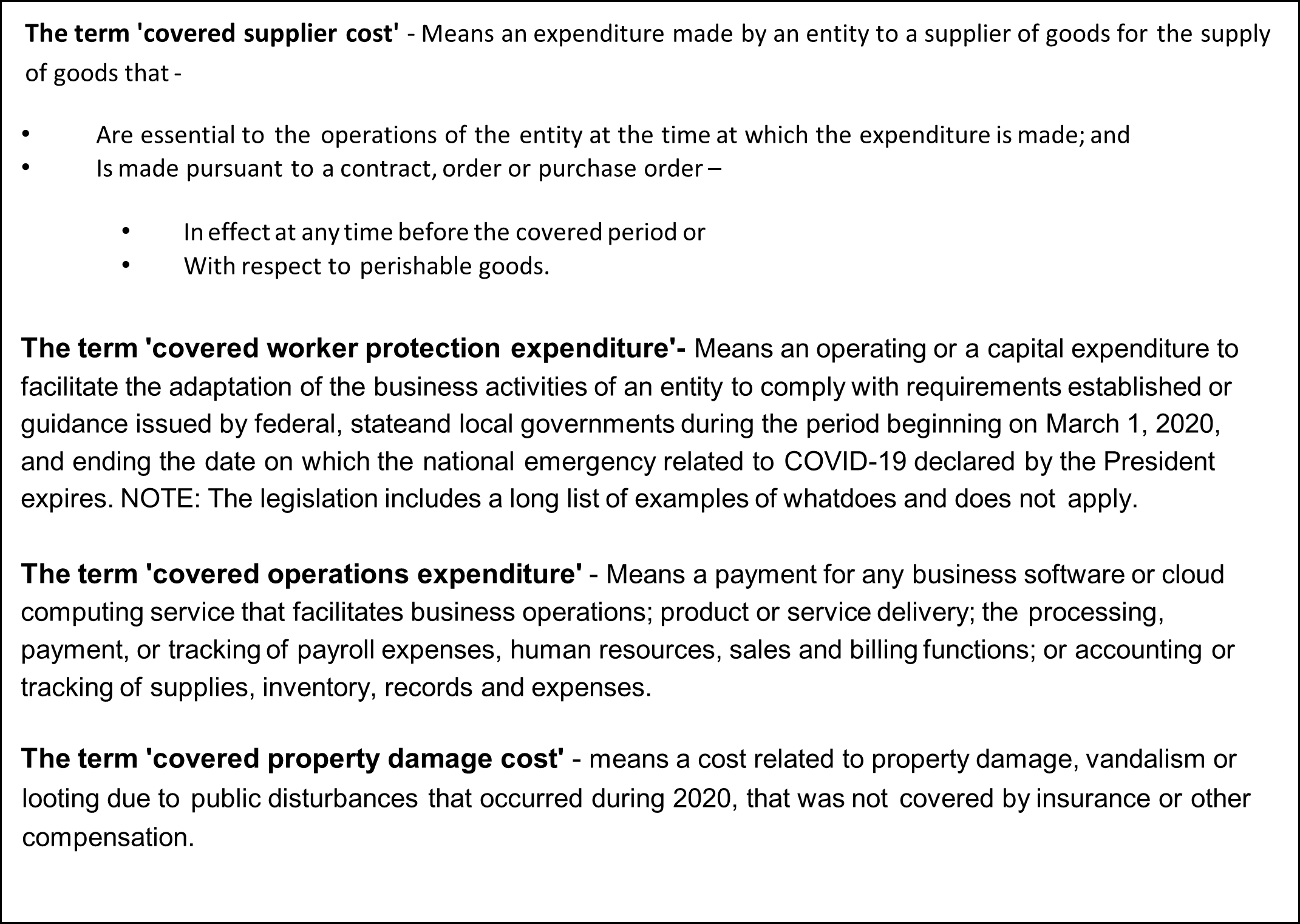
  • Local newspapers and TV and radio stations previously made ineligible by their affiliation with other Forgivable expenses will be expanded to include covered (COVIDTRA Sec 304):
    • Payroll costs – Including additional group insurance payments, inclusive of vision, dental, disability and life insurance.
    • Operational costs.
    • Property damage costs.
    • Supplier costs on existing contracts and purchase orders, including the cost for perishable goods at any time.
    • Investments in facility modifications and personal protective equipment needed to operate safely, and technology operations expenditures.
Loan Size – Establishes a maximum loan size of 2.5 times the average monthly payroll costs, up to $2 million.

  • Allows small businesses assigned to the industry NAICS code 72 (Accommodation and Food Services) to receive PPP second draw loans equal to 3.5 times their average monthly payroll costs in order to help these businesses combat onerous state and local restrictions.
  • Maintains existing expansions in eligibility for businesses assigned to the industry NAICS code 72 (Accommodation and Food Services).

Loan Forgiveness – Full loan forgiveness is available if the borrower spends at least 60% of the second draw on payroll costs over either an 8-week or 24-week period selected by the borrower.

Simplified Loan Forgiveness – The loan forgiveness process is simplified for borrowers with PPP loans of $150,000 or less. (This means another version of the SBA’s loan forgiveness application form will be forthcoming.)

Churches and Religious Organizations -Are eligible for loans. Future administrations are prevented from making them ineligible.

Planned Parenthood – Is ineligible.

Set-Asides – $41 billion is set aside to ensure that smaller borrowers and under-served communities get the help they need, such as:

  • Small businesses with 10 or fewer employees.
  • Small community lenders.
  • Independent live venue operators, including eligible independent movie theaters and museums affected by COVID-19 stay-at-home orders.

Clarification of Tax Treatment of Covered Loan Forgiveness Expenses 

The CARES Act provides that a recipient of a PPP loan may use the loan proceeds to pay payroll costs, certain employee benefits relating to healthcare, interest on mortgage obligations, rent, utilities and interest on any other existing debt obligations. If a PPP loan recipient uses their PPP loan to pay those costs, they can have their loan forgiven in an amount equal to those costs. PPP loan forgiveness doesn’t give rise to taxable income and the Code generally doesn’t allow a taxpayer to deduct expenses that are paid with tax exempt income.

The IRS had issued a ruling essentially saying that since businesses aren’t taxed on the proceeds of a forgiven PPP loan, the expenses aren’t deductible. However, members of Congress have been saying all along that was not the Congressional intent.

In a rebuttal to the IRS, Congress made it crystal clear in the Act that taxpayers whose PPP loans are forgiven, are allowed deductions for otherwise deductible expenses paid with the proceeds of a PPP loan, and that the tax basis and other attributes of the borrower’s assets will not be reduced as a result of the loan forgiveness.

Business Meals 

The Tax Cuts and Jobs Act of 2017 (TCJA) eliminated the deduction for entertainment and curtailed the expense deduction for meals. In a very business friendly transitional guidance (Notice 2018-76) on the deductibility of business meals, the IRS announced that taxpayers generally may continue to deduct the food and beverage expenses associated with operating their trade or business. Under this notice, taxpayers may deduct 50% of an otherwise allowable business meal expense.

Under Sec. 210 of the Taxpayer Certainty and Disaster Tax Relief Act of 2020, for 2021 and 2022, taxpayers will be able to deduct 100% of business meal expenses where the food or beverages is provided by a restaurant, provided:

  • The expense is an ordinary and necessary expense paid or incurred during the taxable year in carrying on any trade or business.
  • The expense is not lavish or extravagant under the circumstances.
  • The taxpayer, or an employee of the taxpayer, is present at the furnishing of the food or beverages.
  • The food and beverages are provided to a current or potential business customer, client, consultant, or similar business Final regulation 1.274-12(b)(3) defines “business associate” as a “person with whom the taxpayer could reasonably expect to engage or deal in the active conduct of the taxpayer’s trade or business such as the taxpayer’s customer, client, supplier, employee, agent, partner or professional adviser, whether established or prospective.

Educator Expense 

The Act specifies that the $250 above-the-line educator expense deduction shall include personal protective equipment (PPE), disinfectant and other supplies used for the prevention of the spread of COVID-19, effective for expenditures after March 12, 2020.

Unemployment Assistance 

All Federal supplemental unemployment insurance benefits, which had already expired or would end on December 31, 2020, will be extended through March 14, 2021. However, the supplemental amount will only be $300 per week instead of the $600 that the CARES Act authorized.

Earned Income Tax Credit (EITC) & Child Tax Credit (CTC) 

These credits are based upon earned income. Because families may have had reduced income during 2020 that would adversely affect the amount of these credits, the legislation allows the 2019 earned income to be used to compute the credits for 2020. However, this affects the computation of the EITC and CTC only and does not affect the 2020 gross income for tax purposes. This is temporary for 2020 only.

Cash Charitable Contributions for Non-Itemizers 

For 2020, the CARES Act allows non-itemizers to deduct $300 of cash contributions, regardless of filing status. The Act of 2020 changes that for 2021, and allows an above-the-line deduction for cash contributions of $600 for joint filers and $300 for all other filing statuses. However, Congress is concerned that taxpayers will abuse this provision and added a 50% underpayment of tax penalty where the contribution cannot be properly documented.  For cash charitable contributions for itemizers, the 60% limit on cash contributions was suspended for 2020, thus allowing larger cash contributions during the COVID crisis. Under the Act, the suspension of the 60% limit has been extended to 2021.

Flexible Spending Arrangements Carryover 

Under current law, cafeteria plans may only permit a carryover of unused amounts remaining in a health FSA as of the end of a plan year in an amount of no more than $550.

The Act extends the carryover period to 12 months after the end of such plan year for unused benefits and contributions to health flexible spending and dependent care flexible spending arrangements for 2020 and 2021.

An employer may also allow an employee who ceases to participate in the plan during calendar year 2020 or 2021 to continue to receive reimbursements from unused benefits or contributions through the end of the plan year in which the employee’s participation ceased, including any extended grace period.

Reduction in Medical Deduction 

AGI Floor-The medical deduction AGI threshold was scheduled to increase to 10% beginning in 2020. The Act makes the 7.5% threshold permanent.

Volunteer Firefighters and Emergency Medical Responders 

Benefits – Under prior law, for tax years beginning in 2020 for any member of a “qualified volunteer emergency response organization,” gross income excluded certain state or local tax relief provided for performing volunteer emergency response services or any payments provided by state or local governments on account of performing volunteer emergency response services. The Act makes this exclusion permanent. (IRC 1398 as amended by Act Sec. 103).

Education Credits Phaseouts Consolidated 

Under prior law, the American Opportunity Tax Credit (AOTC) and the Lifetime Learning Credit (LLC) each had a different phaseout range. Effective for years after December 31, 2020, the Act replaces the dual phaseouts with a single one that applies to both credits. This increases the AGI at which the LLC phaseout begins, which allows more individuals to qualify for the LLC. The phaseout ranges will not be adjusted for inflation in future years.

Filing Status Phaseout Range
Single $80,000 – $90,000
Married Filing Jointly $160,000 – $180,000
Married Filing Separately No Credit Allowed

Discharge of Qualified Principal Residence Indebtedness 

For several years going back to 2008, taxpayers have been able to exclude from income up to $2 Million ($1 Million for Married Filing Separately taxpayers) of home debt forgiveness income. This provision has been previously extended and was scheduled to sunset after 2020. Because so many homeowners are behind in their home mortgage and property tax payments and may lose their homes, the Act extends the provision through 2025, but reduces the maximum exclusion for years after 2020 to $750,000 ($375,000 MFS).

Employer-Provided Educational Assistance 

Educational assistance provided under an employer’s qualified educational assistance program, up to an annual maximum of $5,250, is excluded from the employee’s income. The CARES Act expanded the definition of expenses to include employer payments of the employee’s student loan debt. But this special allowance was only available for payments made between March 27, 2020, through December 31, 2020. The Act extends the exclusion for loan repayments made through 2025.

Mortgage Insurance Premiums 

For tax years 2007 through 2020, taxpayers could deduct, as an itemized deduction, the cost of premiums for mortgage insurance paid in connection with acquisition debt on a qualified personal residence. The deductible amount of the premiums phases out ratably by 10% for each $1,000 by which the taxpayer’s AGI exceeds $100,000 (10% for each $500 by which a married filing separately taxpayer’s AGI exceeds $50,000). If AGI is over $109,000 ($54,500 MFS), the deduction is totally phased out. The Act extends this provision for one year through 2021.

Nonbusiness Energy Credit 

Since 2006, taxpayers have been able to claim a credit for making qualifying energy saving improvements to their existing homes. The dollar limits and credit percentages have been modified several times since the credit first became available. The credit of 10% of the amounts paid or incurred by the taxpayer for qualified energy improvements to the building envelope (windows, doors, skylights and roofs) of principal residences ranges from $50 to $300 for energy-efficient property, including furnaces, boilers, biomass stoves, heat pumps, water heaters, central air conditioners and circulating fans, and is subject to a lifetime cap of $500. The Act extends this credit through 2021.

2-Wheeled Plug-In Electric Vehicle Credit 

The Code provides a 10% credit for highway-capable, two-wheeled, plug-in electric vehicles (capped at $2,500). Battery capacity within the vehicles must be greater than or equal to 2.5 kilowatt-hours. The Act extends this credit for one year so that it applies to property placed in service through 2021.

If you have questions about how this COVID-19 tax legislation might apply in your situation, please give our office a call.


Key Changes to the Employee Retention Credit

On December 27, 2020, President Trump signed the Consolidated Appropriations Act, 2021 (CAA) into law. A recent article from JD Supra outlines two key provisions included in the act that make changes to the employee retention credit.

Established by the CARES Act, the employee retention credit was designed to incentivize employers to maintain their staff in the midst of the coronavirus pandemic. For the period from March 13, 2020, to December 31, 2020, eligible employers could claim a 50% retention credit for qualified wages, capping out at $5,000 per employee.

The CAA both extends and expands the employee retention credit, including making retroactive changes to it for 2020. It does so via two provisions:

Section 206 – This provision makes retroactive changes back to March 13, 2020, when the ERC was established. First, recipients of loans through the Paycheck Protection Program (PPP) are now eligible for the ERC. Previously, PPP participants were barred from claiming the ERC. Employers should note that they may not claim the ERC on wages paid with forgiven PPP loan funds.

Secondly, Section 206 offers clarification regarding “qualified health plan expenses” and the ERC. It explains that these expenses are, indeed, eligible for the ERC, even when they are attributable to a furloughed employee who is not receiving any other compensation at the time.

The third change—another clarification—is in regard to the “gross receipts” test for tax-exempt organizations. In determining their eligibility for the ERC, tax-exempt organizations must account for all gross receipts, not just those from unrelated trade or business activities.

Finally, Section 206 offers employers a means for catching up on unclaimed ERC for 2020. Employers should claim the additional ERC on their fourth quarter Form 941, which is due by January 31, 2021. Further guidance in this area is expected this month.

Section 207 – This second provision includes an extension of the ERC for the period from January 1, 2021 to June 30, 2021. Additionally, it expands the ERC in the following ways:

  • Increases the credit from 50% to 70%, for the portion of 2021 that the ERC covers.
  • Adjusts the per-employee cap on the ERC to $7,000 per quarter.
  • Decreases the eligibility threshold from a 50% decline in gross receipts to a 20% decline.
  • Expands eligibility for the ERC from employers with up to 100 employees to employers with up to 500 employees.
  • Eliminates the qualified wages cap for employee pay increases.
  • Eliminates the option to receive advance payment of the ERC via IRS Form 7200 and/or IRS Form 941 for employers with more than 500 employees.
  • Expands the availability of advance payments of the ERC for employers with 500 or fewer employees.
  • Creates a process for repaying advance payments of the ERC, in the event of excess payments.
  • Makes some governmental employers eligible for the ERC in 2021.
  • Maintains the non-eligibility of the ERC for wages accounted for under IRC Section 45S and expands the non-eligibility to also cover wages accounted for under IRC Section 41, IRC Section 45A, IRC Section 45P, IRC Section 51, and IRC Section 1396.
  • Requires the U.S. Small Business Administration and the IRS to coordinate in a public awareness campaign targeting employers eligible for the ERC.

For further details, click here to read the article in full at JD Supra.

Congress Enacts Additional Stimulus Legislation

On December 22, 2020, Congress passed the Consolidated Appropriations Act, 2021 (CAA2021), which includes $892 billion in coronavirus stimulus spending. This long-awaited and highly contested piece of legislation ties coronavirus relief funding into a $1.4 trillion resolution for funding the federal government through September of next year. The nearly $900 billion in stimulus funds comprises a variety of measures, including a renewal of enhanced unemployment benefits, an extension of the Paycheck Protection Program, and another round of individual stimulus payments. Read on for a breakdown of the various COVID-19 stimulus measures included in CAA2021.


BUSINESS MEASURES


Paycheck Protection Program Extension (PPP2)

Portion of the stimulus package: $284 billion

CAA2021 provides an additional round of funding for the PPP and expands eligibility to include nonprofits (Sec. 501(c)(6)), local newspapers, TV stations, and radio stations. Additionally, it ensures the tax deductibility of business expenses paid with loan funds that are forgiven, a measure that has been widely called for by loan recipients and the American Institute of Certified Public Accountants (AICPA). For further details on PPP2, click here to read a helpful summary from the Journal of Accountancy.


Support for Entertainment Venues

Portion of the stimulus package: $15 billion

Funds for struggling live venues, independent movie theaters, and cultural institutions.


Support for Business in Low-income Communities

Portion of the stimulus package: $12 billion

Funds earmarked for businesses in low-income and minority communities.


Economic Injury Disaster Loan Grants

Portion of the stimulus package: $20 billion

Additional funds to be administered through the Economic Injury Disaster Loan (EIDL) program that are dedicated to businesses in low-income communities.

Support for Child Care Centers

Portion of the stimulus package: $10 billion

Aid money to help child care centers safely reopen and to support families with child care costs. The money is to be administered via the Child Care Development Block Grant.


Aid to Transportation Sector

Portion of the stimulus package: $45 billion

A variety of transportation-related assistance that includes $16 billion for airlines (for paying the salaries of workers and contractors), $14 billion for mass transit agencies, $10 billion for highways, and $1 billion for Amtrak.

INDIVIDUAL MEASURES


Unemployment Benefits

Portion of the stimulus package: $120 billion

An extension of federal unemployment supplemental benefits through March 14, 2021, at a rate of $300 per week.  Additionally, it legislates an extension of two pandemic unemployment programs set to expire at the end of December, the Pandemic Unemployment Assistance program, which has been expanded to provide aid to self-employed, temporary, and gig workers, and the Pandemic Emergency Unemployment Compensation Program, which provides an additional 13 weeks of benefits beyond the typical 26 weeks that states provide to jobless workers.


Extension of Eviction Moratorium & Rental Assistance

Portion of the stimulus package: $25 billion

A temporary extension of the federal eviction moratorium through January 31, 2021, and $25 billion in emergency rental assistance.


Economic Impact Payments

Portion of the stimulus package: $166 billion

Direct payments of $600 for qualifying adults and their child dependents. Individuals earning up to $75,000 annually (or married couples making up to $150,000) qualify for the full payment; individuals earning between $75,000 and $99,000 qualify for a reduced payment; individuals earning more than $99,000 do not qualify.


Food Aid

Portion of the stimulus package: $13 billion

Additional funding for the Supplemental Nutrition Assistance Program and a benefits increase of 15% to last for six months.


ADDITIONAL MEASURES


Support for Education Institutions

Portion of the stimulus package: $82 billion

This money is designated to help schools and universities reopen. The funds are earmarked as follows: $54 billion for public K-12 schools, $23 billion for colleges and universities, $4 billion for the Governors Emergency Education Relief Fund, $2.75 billion for private K-12 education, and nearly $1 billion for Native American schools.


Funding for Vaccine Distribution and Coronavirus Testing

Portion of the stimulus package: $68 billion

CAA2021 includes money for both supporting the distribution of coronavirus vaccinations and for helping to pay for costs associated with COVID-19 testing. $30 billion is directed for the procurement of vaccines and treatments, the funding of distribution for states, and the creation of a strategic stockpile. $22 billion is earmarked for testing, tracing, and mitigation. Of the remaining funds, $9 billion will go to healthcare providers and $4.5 billion is earmarked for mental health.


Increased Broadband Access

Portion of the stimulus package: $7 billion

Funding for broadband initiatives to support better connectivity and infrastructure. $3.2 billion is earmarked for the Emergency Broadband Benefit, which provides low-income families and individuals laid off or furloughed due to the pandemic with a monthly stipend of $50 to pay for internet services. $1.9 billion is dedicated to financing “rip and replace” projects—the removal and replacement of Huawei and ZTE networking equipment. $1 billion will go to Tribal broadband programs and $300 billion is dedicated to rural broadband deployment.


Farm Aid

Portion of the stimulus package: $13 billion

Funding for farmers and ranchers.


Postal Service

Portion of the stimulus package: $10 billion

CAA2021 includes the forgiveness of a $10 billion loan made to the United States Postal Service earlier this year.


WHAT’S NOT INCLUDED


A number of provisions that were initially included in proposed coronavirus stimulus legislation were, ultimately, left out of the bill. These include protection for businesses against litigation regarding COVID-19 exposure, financial aid to state and local governments, and an extension of federal student loan forbearance.

Local Accounting Firm Celebrates 40 Years in the Community

Carmel, IN – The local full-service accounting and consulting firm of Slattery & Holman, P.C. is pleased to announce the celebration of 40 years of service.

“Forty years is an exceptional accomplishment for our firm,” said Dennis Slattery, CPA, co-founder and former managing partner of Slattery & Holman, P.C. “Our long-term success is a direct result of the value we place on client relationships, as well as our dedicated staff, who strive to provide the highest quality service each and every day.”

Slattery & Holman, P.C. is comprised of a diverse group of seasoned accounting professionals and has strong roots in the local community. Since opening their doors in 1980, the firm has provided a variety of assurance, consulting and tax services to help clients improve their overall financial success.

“At Slattery & Holman, we recognize that without our clients’ support, we would not have cause to celebrate our many years of service,” said Slattery. “With this in mind, we would like to extend our most sincere gratitude to our clients for their confidence in our firm.”

Established in 1980, Slattery & Holman, P.C. offers full-service accounting and consulting services to businesses and individuals throughout Indiana and nationwide. The firm serves clients in a variety of industries, with a particular focus on construction contractors, manufacturers and distributors, long-term care facilities, and medical, dental and veterinary practices. The Slattery & Holman, P.C. trusted advisors provide personal attention to each and every client, helping them to identify and reach both their short- and long-term financial goals. For more information, visit slatterycpa.com.


Employee Spotlight – Michelle A. Kerr

Michelle Kerr

Get to Know Michelle

What year did you join Slattery & Holman?
2004

Tell me a little about where you attended college and the degree(s) you earned. Any special accomplishments?
I started at IU Bloomington for my first two years and finished my last year at IUPUI after coming to Indy for a summer to live with a friend. I got a full-time job in my field of study that summer and ended up staying for the fall semester while taking a full load of evening classes so I could gain experience. I finished undergrad in 3 ½ years.

What is your favorite thing about living in Indiana?
I was born and raised in Indiana. The best things about living here are the people, the experience of having all four seasons. I love the lush green leaves in the spring and the beautiful colors of the fall.  Winter is last on the list, but it works out well for those of us who are CPAs. Not sure I could do a tax season in Hawaii or another place where there are cool things to do outdoors during the busy season.

If you didn’t have to sleep, what would you do with the extra time?
Well, I actually like to sleep as that is a beautiful time when our bodies rest, restore and recover. But, if I had extra time, I would love to be outside more, I love all things movement; hiking, biking, kayaking, tennis, pilates, yoga, paddleboarding. I would love to learn to play piano or the guitar.

What fictional place would you most like to visit?
Neverland

What is a new skill that you would like to master?
Self-mastery, staying present.

What do you wish you knew more about?
The science of the mind and how powerful it is…the mind is the government that runs the body.

What’s the farthest you’ve ever been from home?
Bali, Indonesia

What question would you most like to know the answer to?
Taxes! Hahaha

What is the most impressive thing you know how to do?
Taxes

What was the best compliment you’ve ever received?
The best compliment is when people say I have a huge heart, I’m all heart.

What is your favorite childhood memory?
My brother and I had a lemonade stand that landed in the local newspaper for our entrepreneurial spirit.

Lemonade Stand

What is your favorite smell?
Stress Away essential oil, homemade cookies, the smell of the ocean.

If you had a clock that would countdown to any one event of your choosing, what event would you want it to countdown to?
A countdown to my next travel excursion.

When was the last time you climbed a tree?
I am not sure I have ever climbed a tree! Maybe a treehouse when I was a little kid.

What’s the most unusual thing you’ve ever eaten?
I was not an adventurous eater up through my 20s, but I have tried lots of new things in my travels…probably octopus.

What was your first job?
My first job (other than babysitting, cleaning my 7th-grade teacher’s house through high school and college, and working in my dad’s insurance and real estate business), was a bank teller at Old National Bank in Terre Haute, IN.

If you could have any superpower, what would it be?
Time travel

12 Financial Metrics Small Business Owners Should Track

Operating a small business is an exhilarating and, at times, overwhelming endeavor. There are so many details to keep track of that it’s easy to forget about the nuts and bolts of your organization’s finances – especially if you didn’t start out as a “numbers person.” Whether you’re the one assembling your financial reports or you’ve hired a professional to do it, it’s important for you to know which of the numbers are most important and what they mean in terms of the decisions you make and your assessment of your business’s overall health. Below is our list of 12 of the most important elements of your financial report and what you can do with the information.

1. Profit and Loss

Every quarter, you should refresh your business’s profit and loss report to understand both your bank and tax reporting needs. It is the snapshot of your bottom line that you can use to drive your decisions and show to an outsider for them to gauge your strength. If you have a reconciled balance sheet, it will ensure that everything in your P & L has been captured.

2. Average Cost of Customer Acquisition

We all want customers, especially customers who keep spending or who spend big. Though it’s tempting to assume a “whatever it takes” attitude, you need to know the average cost of acquiring profitable customers and then assess whether you can cut those costs in order to make them even more profitable. Knowing the average cost of customer acquisition can also help you figure out how much to spend on customer retention.

3. Budget Versus Actual

Think you’re sticking to the plan based on what you see in terms of your bank account? The truth is that if you compare what you’ve budgeted to what you’ve actually spent, it will give you a far better sense of whether you’re staying on track and what kind of adjustments you need to make.

4. Cash Flow

Most people consider cash flow the most telling metric of all, and cash certainly is the lifeblood of any company. If you’re not keeping an eye on cash flow, you could find yourself caught off guard when it comes to making essential payments. Make measuring your cash flow, cash burn (the amount you go through monthly) and runway (how much you can operate based on your cash on hand) part of your regular business health check.

5. Fixed Burn Rate

No matter how well you’re doing, there is always the chance that you’re going to encounter some unforeseen circumstance or drop in business that is going to drive the need to cut costs. The best way to do that is to take a close look at your fixed burn rate and make sure it isn’t too high. As tempting as it may be to sign on to a long-term contract to save a little money, if you commit yourself to a payment you can’t afford at all in the future, you may be sorry. You might be better off removing some of those expenses from a contracted status so that you can eliminate them should the need arise.

6. Employee Productivity

Though it’s a given that your employees are your most valuable asset, that doesn’t mean you should be operating without ensuring you’re getting enough value out of them to justify what you’re spending. The best way to do that is to actually monitor each employee’s productivity to make sure everybody is pulling their weight.

7. Operating Cash Cycle

When a business wants to expand, they can’t move forward blindly. They need to have a good handle on how long it takes for cash to become available after their capital investment so they can feel confident in their ability to go through with the plans. Those who fail to understand their operating cash cycle risk joining the ranks of the 82% of businesses that fail due to poor cash flow management (according to U.S. Bank).

8. Churn Rate

When you think about how hard you work to acquire new customers, it’s no wonder that knowing how long you’re holding on to them is a key metric. If you’re churning through customers too quickly, it means that your product or service isn’t valuable enough to them to stick around for more. Understanding how soon they’re leaving, and the reason for it, is the first step in stopping the bleeding and making your business more profitable for the long term.

9. Regulatory Requirements for Your Industry

It’s easy to forget about regulatory requirements such as renewing your industry license or maintaining minimum capital, but failing to keep track of them leads to unnecessarily having to pay noncompliance penalties. Make sure that you include these elements within your financial report and calendar.

10. Projected Profit Loss Versus Actual

A big part of your annual financial plan should include a projection of what you believe your profit and loss will be, as well as a budget for each of your expense areas. Having this will allow you to compare what you projected to what your actual profit and loss is, and to then review where things went askew. Some discrepancies may be explainable and worthwhile, while others may be warnings of things getting out of control.

11. Profit Goals and Profit Per Customer

One of the most effective ways to promote profitability is to take a granular, analytical approach to your profit goals. By determining your short-term and long-term profit goals, you can then break it down to what your profit goal is, per customer, based on either your existing customers or the number of new customers you need to acquire. All of these numbers can drive internal processes and help you get where you want to go.

12. Financial Ratios

Ratios are among the most useful metrics that a small business owner can use to determine the overall financial health of their organization. Among the most important are their liquidity ratio (how much cash you have on hand to pay the monies you owe), efficiency ratio (how much it is costing you to bring in a single dollar) and profitability ratio (profit as it compares to revenue).

Each of these elements is extremely beneficial in helping you understand where your money is at any time. If you’d like to discuss how our services can help you run a successful business, please contact us for more information.

The SBA Issues a Simplified PPP Loan Forgiveness Application

If you are the owner of a small business that obtained a Paycheck Protection Program (PPP) loan, you are most likely aware that the loan can be partially or totally forgiven if you used the loan proceeds for the required purposes. Loan forgiveness is not automatic and must be applied for. The borrower must submit a request to the lender or, if different, the lender who is servicing the loan, who then must make a decision upon the amount of forgiveness within 60 days.

The request must include documents to verify the number of full-time equivalent (FTE) employees and pay rates, as well as the payments on eligible mortgage, lease and utility obligations. The borrower must certify that the documents are true and that the borrower used the forgiveness amount to keep employees and make eligible mortgage interest, rent and utility payments.

The process of obtaining a PPP loan and applying for forgiveness has been complicated from the start, with guidance from the Small Business Administration (SBA) and the IRS coming in dribs and drabs; for a while, it seemed that the rules were modified every week. The original forgiveness application provided by the SBA was horrendously complicated and one almost needed an accounting degree to figure it out. It required the applicant to complete numerous complicated side computations and did not provide any corresponding worksheets.

To clarify the process, Congress stepped in and passed the Paycheck Protection Program Flexibility Act. As part of that legislation, the SBA was required to simplify the forgiveness application. In response, the SBA did somewhat simplify Form 3508, the original forgiveness application, and created an easier version: Form 3508EZ.

The 3508EZ is for use by:

  • Self-employed borrowers with no employees.
  • Generally, borrowers with employees who, during the covered period,
    • Did not reduce the annual salary or hourly wages of any employee by more than 25%;
    • Did not reduce the number of employees or the average paid hours of employees; and
    • Was unable to operate during the covered period at the same level of business activity as it did before February 15, 2020, due to compliance with requirements established or guidance issued by the Department of Health and Human Services, Centers for Disease Control and Prevention or Occupational Safety and Health Administration.

During the week of October 5th, the SBA released yet another simplified application, SBA Form 3508S, along with instructions for its use. This form can only be used if the total PPP loan amount the borrower received from their lender was $50,000 or less.

A borrower who qualifies for and uses SBA Form 3508S (or their lender’s equivalent form) is exempt from any reductions in the borrower’s loan forgiveness amount based on reductions in FTE employees or employee salaries or wages from the CARES Act that would otherwise apply.

While SBA Form 3508S does not require borrowers to show the calculations they used to determine their loan forgiveness amount, the SBA may request information and documents to review those calculations as part of its loan review process. Accordingly, the borrower must retain, for 6 years from the date when the loan is forgiven or repaid, all documentation submitted with the loan application to prove the borrower’s certification of eligibility for the PPP loan and material compliance with the PPP’s requirements, and to back up the loan forgiveness application.

Keep in mind that the application for forgiveness, which can be submitted electronically, must be submitted within 10 months after the end of the covered period to the borrower’s lender or the lender servicing the borrower’s loan.

If you have questions about how these changes might apply to your situation or need assistance with completing your forgiveness application, please give our office a call.

Don’t Miss Out on Year-End Tax Planning Opportunities

To say COVID-19 has made 2020 a disastrous year for just about everyone would be an understatement. In response to the economic slowdown and losses of income, Congress passed several extensive laws to benefit individuals and businesses that suffered financial hardship because of COVID-19. However, 2020 has given rise to more than the usual tax planning opportunities. Thus, you may find it appropriate to schedule a tax planning appointment before the close of the year to take advantage of the tax benefits and strategies available for 2020. Although everyone’s situation is unique, the following are examples of tax opportunities and strategies that may apply to you.

Individual Planning Opportunities

Did You Collect Unemployment Income This Year? If you did, you should be aware that it is taxable for federal purposes and that most states also tax unemployment benefits. Even if you had taxes withheld from the unemployment payments, don’t be misled into thinking it will be enough. Generally, the tax withheld from unemployment compensation is insufficient, especially when the extra $600 weekly amount of federal pandemic benefits is considered. It may be appropriate to see what effects the unemployment income will have on your taxes and avoid any unpleasant surprises next year when your return is prepared.

Did You Skip the Required Minimum Distribution (RMD) for 2020? Taxpayers were allowed to skip their RMD from their IRAs and most other retirement plans for 2020. But that might not be your best tax move, especially if you can take a distribution that will result in no or minimal taxes for this year. It may be appropriate to discuss whether you should take a distribution or not. We might be able to determine an amount that can be withdrawn tax-free.

Are You the Charitable Type? If so, 2020 offers a variety of ways to make contributions, including donating unused time off from work (if your employer participates in the program). The AGI limitation for deducting cash contributions has been increased significantly, and non-itemizers can make a deductible contribution of up to $300 (pending legislation may change the amount). Of course, a taxpayer over age 70½ can make contributions directly from a traditional IRA to a qualified charity. We can determine the method or combination of methods best suited to your particular circumstances.

Did You Have a Large Increase in Income This Year? If so, you might want to explore the benefits of a donor-advised fund, which will allow you to make a large deductible charitable contribution this year and meet your future charitable obligations by distributing the funds in upcoming years.

Divorced or Separated This Year? Divorce creates numerous issues that can have profound implications on your tax return and the amount of your tax liability. For example, who takes credit for the kids, allocating taxable income, who benefits from tax credits and deduction carryovers, alimony and who is responsible for the tax liabilities are just a few issues to consider. It might be appropriate to project your tax liability in advance, so you can prepare for the outcome.

Do You Have Health Insurance? Although the federal government no longer penalizes individuals for not having minimal essential health insurance, some states do. The penalties can be a substantial amount of money and should be considered in year-end tax planning.

Did You Suffer a Disaster Loss in 2020? There are special rules related to evaluating the losses incurred as the result of a disaster, and the results are likely quite different from what you might imagine.

Did Your Child File a Tax Return in 2018 or 2019 Under the Kiddie Tax Rules? If so, Congress has retroactively provided an alternative computation that could result in a substantial refund.

Congress Extended Tax Benefits That Expired After 2017. Some of those benefits may apply to you for 2020. Or, you can amend your returns for 2018 and 2019 (as appropriate) to take advantage of the following benefits: forgiveness of qualified principal residence debt income; deduction of mortgage insurance premiums; credit for energy-efficient home improvements; and credits for fuel cell vehicles, two-wheeled electric vehicles and alternative fuel refueling property.

Did You Sell Your Home This Year? If so, and you meet the ownership and occupancy tests, the gain from selling your main home will not be taxed up to $250,000 ($500,000 if you file a joint return with your spouse). If you don’t meet the requirements of both owning and using your home for at least 2 years in the 5 years prior to the sale date, you may still qualify for a partial home sale gain exclusion. For example, you may qualify for a reduced exclusion if you sold your home to relocate this year because of a change in employment or due to health. We can determine the amounts of excluded income and taxable gain, and project how your taxes will be impacted.

Have You Prepaid Enough Tax for 2020? One of the reasons for doing year-end tax planning is to determine if the tax you’ve already paid through withholding or estimated tax payments will be sufficient to cover your tax for the year in order to avoid a penalty for underpayment of estimated tax. If there’s a shortfall, we can see what steps you can take either to reduce the tax (perhaps by increasing your retirement plan contributions or bunching deductions) or increase your withholding for the rest of the year.

Business Planning Opportunities

Did You Place Qualified Improvement Property in Service During 2018, 2019 or 2020? Congress made a retroactive law change that allows a business owner to expense the costs of qualified improvement property in the year when it goes into service. This is instead of depreciating the cost of the improvement and claiming that deduction over a number of years. Qualified improvement property generally means any improvement to an interior portion of a building that is nonresidential real property, if the improvement is placed in service after the date the building was first placed in service.

Did You Have a Business Loss in 2018 or 2019? If you incurred a net operating loss (NOL) in 2018 or 2019, changes made by the CARES Act retroactively allow taxpayers to carry those losses back 5 years. This entails amending your returns for the earlier years to deduct the loss being carried back in order to get a refund on income taxes paid in those years.

Are You a Working Shareholder in an S Corporation? If so, you may not be aware of the IRS’s “reasonable compensation” requirements, which can influence your Section 199A (qualified business income) deduction and payroll taxes. Reviewing the requirements as they apply to your particular circumstances may avoid future problems with the IRS.

Did You Secure a Paycheck Protection Program Loan From the SBA? If so, you will need to apply for loan forgiveness if you haven’t already. The SBA forgiveness applications can be quite challenging. We can assist with completing the application and help you maximize your forgiveness.

Did You Have a Large Capital Gain in 2020? If so, you may want to consult with us about investing in a Qualified Opportunity Fund (QOF) to defer the taxable gain until 2026. Unlike Section 1031 tax-deferred exchanges, only the profits need to be invested in a QOF, not all the proceeds from the sale that resulted in the capital gain.

Other Planning Ideas
In addition to the situations above, some customary tax planning issues may also apply to you in 2020. Here are some examples:

  • You could bunch deductions to itemize in one year and take the standard deduction in the subsequent year.
  • Depending on your 2020 income, it may be appropriate to accelerate or defer your income and deductions. This will be especially crucial during 2020.
  • Are you considering marriage or divorce? Some circumstances might warrant waiting until after the end of the year.
  • If you expect your income to be abnormally low in 2020, this may be an opportunity to cash in on stock gains or exercise stock options while incurring little or no tax liability.
  • As always, those with large estates may find it appropriate to make annual gifts of $15,000 per recipient (no limit on the number of recipients) to reduce the value of the estate. Married couples can gift $30,000 to each recipient. Giving appreciated assets will transfer the taxable gain to the recipient.

Opportunities for tax benefits and reducing your tax liability abound for 2020. Please contact our office for a virtual tax planning appointment and continue to be safe during these trying times.

Are You Reaping the Full Benefits of Your HSA?

The Health Savings Account (HSA) is one of the most misunderstood and underused benefits in the Internal Revenue Code. Congress created HSAs as a way for individuals with high-deductible health plans (HDHPs) to save for medical expenses that are not covered by insurance due to the high-deductible provisions of their insurance coverage.

HSA as a Retirement Vehicle – Although the tax code refers to these plans as “health” savings accounts, an HSA can act as more than just a vehicle to pay medical expenses; it can also serve as a retirement account. For some taxpayers who have maxed out their retirement plan options, an HSA provides another resource for retirement savings—one that isn’t limited by income restrictions in the way that IRA contributions are.

Since there is no requirement that the funds be used to pay medical expenses, a taxpayer can pay medical expenses with other funds, allowing the HSA to grow (through account earnings and further tax-deductible contributions) until retirement. In addition, should the need arise, the taxpayer can still take tax-free distributions from the HSA to pay medical expenses. Unlike traditional IRAs, no minimum distributions are required from HSAs at any specific age.

Withdrawals from an HSA that aren’t used for medical expenses are taxable and subject to a 20% penalty, with one exception: an individual age 65 or older will pay income tax on non-medical related distributions from their HSA, but won’t owe a penalty for using the funds for non-medical expenses.

Example: Henry, age 70, has an HSA account from which he withdraws $10,000 during the year. He also has unreimbursed medical expenses of $4,000. Of his $10,000 withdrawal, $6,000 ($10,000 – $4,000) is added to Henry’s income for the year, and the other $4,000 is both tax-free and penalty-free. If Henry had been 64 years old or younger, he’d be taxed on the $6,000 and pay a penalty of $1,200 (20% of $6,000).

Eligible Individual – To be eligible for an HSA in a given month, an individual:

  1. Must be covered under an HDHP on the first day of the month;
  2. Must NOT also be covered by any other health plan (although there are some exceptions);
  3. Must NOT be entitled to Medicare benefits (i.e., generally must be younger than age 65); and
  4. Must NOT be claimed as a dependent on someone else’s return.

Any eligible individual—whether employed, unemployed or self-employed—can contribute to an HSA. Unlike an IRA, there is no requirement that the individual have compensation, and there are no phase-out rules for high-income taxpayers. If an HSA is established by an employer, then the employee and/or the employer can contribute. Anyone, not just family members, can make contributions to HSAs on behalf of eligible individuals. Both employer and employee contributions made via the employer’s cafeteria plan are excluded from the employee’s gross income. Employees who make HSA contributions outside of their employers’ arrangements are eligible to take above-the-line deductions—that is, they don’t need to itemize deductions—for those contributions.

The Monetary Qualifications for an HDHP:

Minimum Annual Deductible Maximum Annual Out-Of-Pocket Expenses
Coverage 2020 2021 2020 2021
Self-Only $1,400 $1,400 $6,900 $7,000
Family $2,800 $2,800 $13,800 $14,000

Example: Family Plan Does Not Qualify: Joe has purchased a medical insurance plan for himself and his family. The plan pays the covered medical expenses of any member of Joe’s family if that family member has incurred covered medical expenses of over $1,000 during the year, even if the family as a whole has not incurred medical expenses of over $2,800 during that year. Thus, if Joe’s medical expenses are $1,500 during the year, the plan would pay $500. This plan does not qualify as an HDHP because it provides family coverage with an annual deductible of less than $2,800.

Example: Family Plan Qualifies: If the coverage for Joe and his family from the example above included a $5,000 family deductible and provided payments for covered medical expenses only if any member of Joe’s family incurred over $2,800 of expenses, the plan would then qualify as an HDHP.

Maximum Contribution Amounts – The amounts that can be contributed are determined on a monthly basis and are calculated by dividing the annual amounts shown below by 12. Thus, if an individual’s health plan only qualified that person for an HSA for 6 months out of the year, then that person’s contribution amount would be half of the amount shown.

Maximum Annual Contribution
Year 2020 2021
Self-Only $3,550 $3,600
Family  $7,100 $7,200

In addition to the amounts shown, an eligible individual who is age 55 or older can contribute an additional $1,000 per year.

How HSAs are Established – An eligible individual can establish one or more HSAs via a qualified HSA trustee or custodian (an insurance company, bank or similar financial institution) in much the same way that an individual would establish an IRA. No permission or authorization from the IRS is required. The individual also is not required to have earned income. If employed, any eligible individual can establish an HSA with or without the employer’s involvement. Joint HSAs between a husband and wife are not allowed; however, each spouse may have a separate HSA (and only if eligible).

Qualified Medical Expenses – To be non-taxable and penalty-free, distributions must be for unreimbursed expenses paid by the HSA account owner, their spouse or dependents for medical expenses that have the same definition as medical expenses for purposes of the medical itemized deduction.

Amounts paid for medicine or drugs are qualified medical expenses for HSA distribution purposes only if the medicine or drug is prescribed (determined without regard to whether such a drug is available without a prescription) or insulin.

The qualified medical expenses must be incurred only after the HSA has been established, and medical expenses paid or reimbursed by HSA distributions cannot also be claimed as medical expenses for itemized deduction purposes.

Generally, health insurance premiums are NOT qualified medical expenses for HSA purposes, except for the following:

  • Qualified long-term care insurance (but only up to the amount of the annual age-based limit that applies for deducting long-term care premiums as medical expenses);
  • COBRA health care continuation coverage;
  • Health care coverage while receiving unemployment compensation; and
  • For individuals age 65 or over, premiums for Medicare A, B or D, Medicare HMO and the employee share of premiums for employer-sponsored health insurance, including premiums for employer-sponsored retiree health insurance (but not Medigap policies).

Menstrual Products – Effective for tax years 2020 and later, the CARES Act added a provision that permits tax-free reimbursement from health savings accounts for costs of menstrual products.

Telehealth – The rule has been that taxpayers may only make contributions to HSAs while they are covered by a high-deductible health plan. However, the CARES Act allows a high-deductible health plan to provide telehealth and remote care services without a deductible for 2020 and 2021.

If you have questions related to the medical tax benefits of an HSA or how an HSA can supplement your retirement planning, please call our office.


Beware of COVID-Related Text Scams

On Wednesday, November 4, the Internal Revenue Service (IRS) released a warning about a new text scam involving a $1,200 Economic Impact Payment. The goal of this scam is to gain bank account information from taxpayers.

The text message includes a message such as “You have received a direct deposit of $1,200 from COVID-19 TREAS FUND. Further action is required to accept this payment into your account. Continue here to accept this payment …” followed by a phishing web address.

If you suspect that you may have received a fraudulent communication from somebody imitating the IRS, please reach out to phishing@irs.gov. You can also report suspected scams at irs.gov.

For more details, click here to read the IRS release in full.